
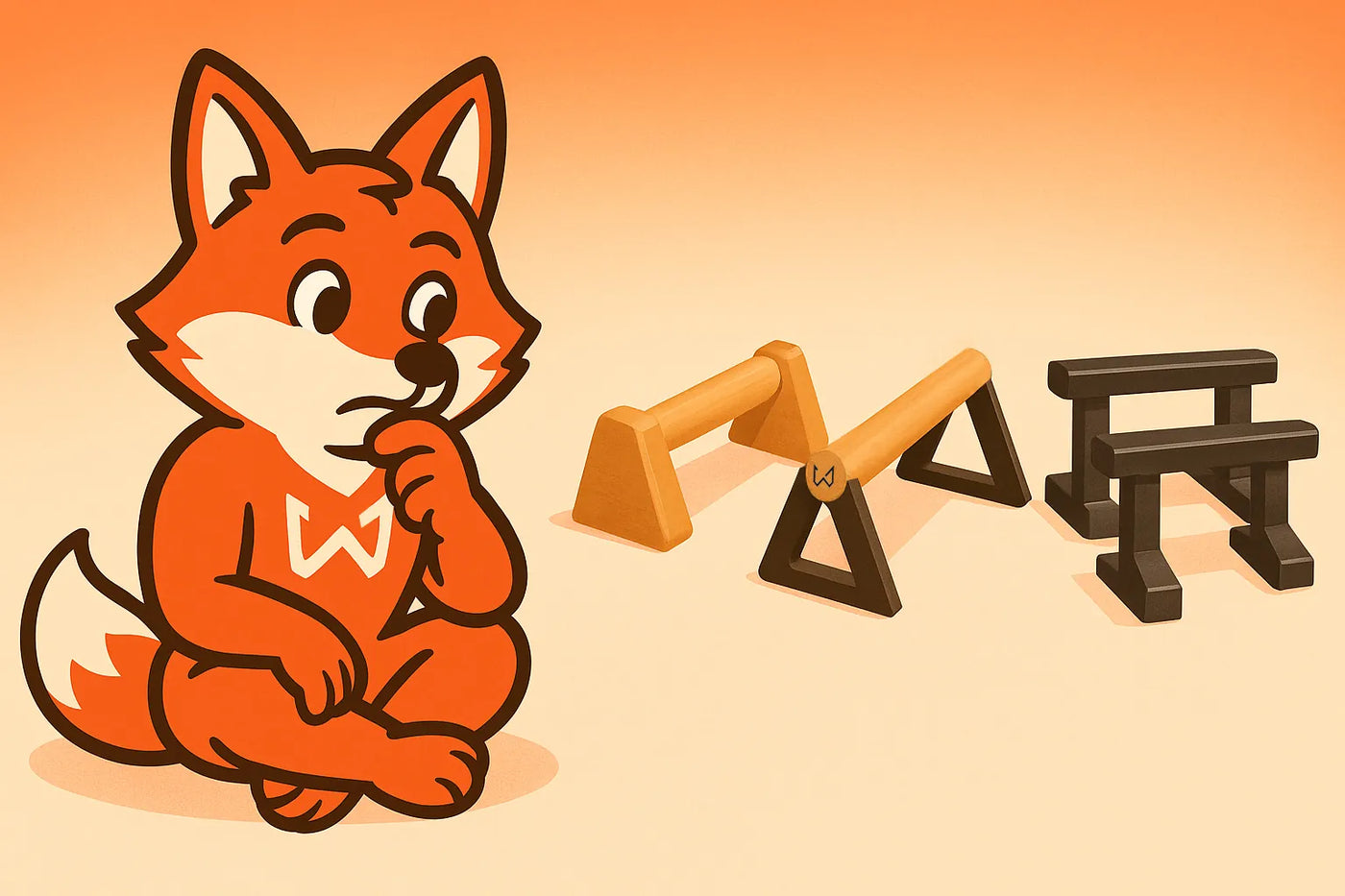
For athletes who value both portability and stability, hybrid parallettes are often the most balanced option. They combine a wooden grip with a steel base, making them practical for home training, outdoor sessions, and travel without sacrificing rigidity under load.
Why the type of parallette matters
Whether you train on tile, wood flooring, or outdoor concrete, the material and construction of your parallettes directly affects how your sessions feel. The grip surface determines comfort during long holds and sweaty sessions. The base design affects how stable the bars feel when you press into a handstand or planche lean. And the weight determines whether you actually use them every day or leave them on a shelf.
These are not just spec sheet differences. They show up in every single training session.
If you are starting from scratch, the Calisthenics Starter Set includes everything you need to begin training right away.
The three types at a glance
Wooden parallettes
Around 0.9 kg, up to 150 kg load
- Very lightweight and portable
- Warm, natural grip feel
- Budget-friendly starting point
- Lower structural stability under heavy load
- Untreated or lower-quality wood can wear faster with heavy use
Good for: Beginners and light travel sessions
Metal parallettes
6+ kg, up to 500 kg load
- Maximum stability under any load
- Built for heavy or weighted training
- Very long lifespan
- Heavy and difficult to move daily
- Cold grip with no sweat absorption
Good for: Fixed home gym setups
Hybrid parallettes
Around 1.3 kg, up to 250 kg load
- Lightweight yet structurally stable
- Wood grip absorbs sweat naturally
- Steel base resists flex under load
- Rust-resistant powder coating
- Travels easily, stores compactly
Good for: Daily training, travel, and skill work
What to look for before buying
Beyond material type, these are the practical details that make a real difference in training. They are often left out of buying guides, but they matter more than most headline specs.

Side-by-side comparison
| Feature | Wooden | Metal | Hybrid |
|---|---|---|---|
| Weight | Around 0.9 kg | 6+ kg | Around 1.3 kg |
| Stability under load | Moderate | Very high | High |
| Grip when sweating | Natural wood | Slippery | Natural wood |
| Rubber feet quality | Basic | Varies | Anti-slip pads |
| Rust resistance | N/A (wood) | Rusts if bare | Powder-coated |
| Portability | Excellent | Poor | Excellent |
| Load capacity | Around 150 kg | Up to 500 kg | Around 250 kg |
| Noise on hard floors | Quiet | Louder | Quiet |
| Assembly | Pre-assembled | One-time setup | One-time setup |
For a broader equipment guide, see Top 5 Calisthenics Equipment.
Which type suits which athlete
Based on testing these parallettes across indoor tile, hardwood, and outdoor concrete, in sessions ranging from push-up volume work to tuck planche holds and handstand practice, the practical differences between types are most noticeable in two areas: grip comfort during longer holds and floor stability on smooth surfaces.
Wooden parallettes work well as a first pair for general beginners or as a dedicated travel option for lighter sessions. The all-wood construction feels warm and natural, but it can feel less planted during more demanding static work under higher loads.
Well-built metal parallettes are typically more stable and durable than other types, making them a good fit for daily users with a permanent training area who prioritise maximum load capacity and do not need to move equipment regularly.
Hybrid parallettes, a powder-coated steel base with a wooden handle, are the option that holds up across the widest range of conditions. The steel base stays planted on tile and hardwood. The wooden grip remains comfortable and non-slip even when hands sweat. The powder coating handles outdoor use without rusting. For versatile buyers who train in different locations or simply want one pair that works everywhere, hybrid is the most consistently practical choice.
This guidance is based on real use factors such as grip comfort, floor stability, portability, and day-to-day training practicality rather than headline specs alone.
For daily users who want portable parallettes that perform well for home training, outdoor sessions, and progressive skill work, from push-ups and L-sits to planche progressions, the Wild Dynamics Hybrid Parallettes balance weight, stability, and grip comfort in a compact, straightforward package.
See Why Athletes Choose Hybrid ParallettesExercises you can unlock
The parallette type you choose also affects which exercises are realistic to train consistently. Here is a practical breakdown by level. For a full visual guide covering all 15 movements with technique notes, see the 15 Best Parallettes Exercises guide.
- Push-up variations
- Plank holds
- L-sit progressions
- Mountain climbers
- Handstands
- Tuck planche
- Archer push-ups
- Crow position
- Handstand push-ups
- Deficit pressing work
- Straddle planche
- Full planche
Pair parallettes with Resistance Bands for assistance progressions, or Wrist Wraps for extra joint support during skill work. New to calisthenics? The Starter Set bundles everything you need to begin.
Frequently asked questions
Are wooden or metal parallettes better?
What height should parallettes be?
Are parallettes worth it?
Can beginners use parallettes?
What is the difference between push-up bars and parallettes?
Do parallettes help with wrist pain?
Can I use parallettes outdoors?
How do I choose between mini parallettes and full-size parallettes?
Final thoughts
Wooden parallettes are portable and affordable but have real limitations for more demanding training. Well-built metal parallettes offer maximum stability but are heavy and impractical outside a fixed gym. Hybrid parallettes sit between the two in a way that works for the widest range of real-world training scenarios, stable enough for planche and handstand work, light enough to carry daily, and comfortable enough for long sessions on any surface.
The right choice depends on how and where you train. For daily users training at home, outdoors, or across different locations, the hybrid option is typically the most practical long-term investment.
Explore Hybrid Parallettes Built for Daily Training


