
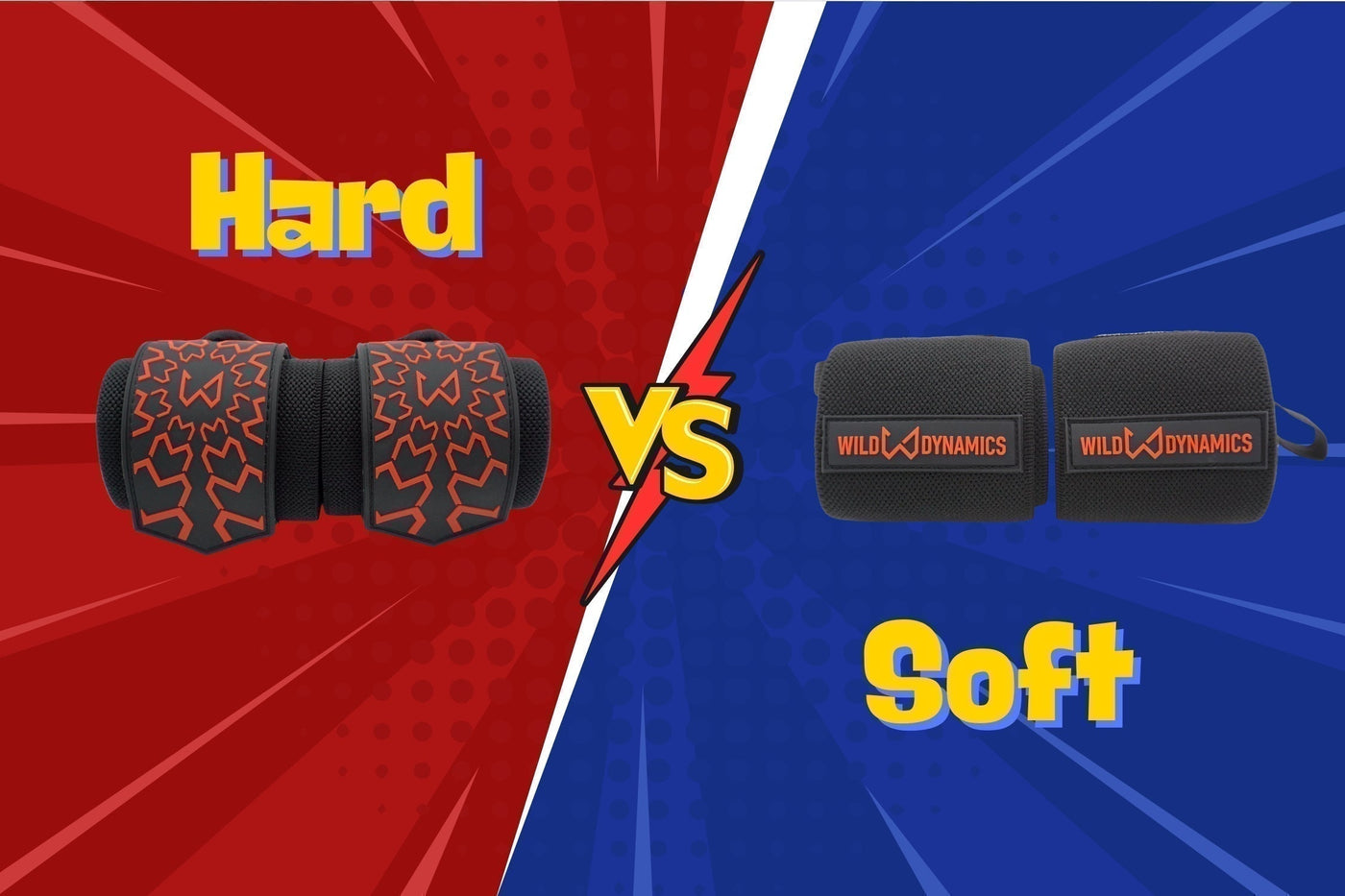
Hard wrist wraps are for heavy, loaded, and isometric work — weighted dips, weighted pull-ups, planche leans, handstand push-ups. Soft wrist wraps are for skill and flow work — handstand practice, ring transitions, explosive push-ups. Most serious athletes keep both and switch per session. If you only buy one: go soft for skill-focused training, hard for strength-focused training.

Why wrist wraps matter in calisthenics
In calisthenics, your wrists absorb force constantly — through push-ups, dips, handstands, and ring work. Unlike barbell training where load is distributed across a wide bar, bodyweight movements concentrate stress directly through the wrist joint in extended or compressed positions. That accumulates fast.
Good wrist wraps do three things: stabilise the joint under load, improve proprioception (your sense of joint position), and reduce compressive stress on tendons and ligaments during repeated high-rep sets. They're not a shortcut — they're a precision tool. And before any loaded wrist work, a proper warm-up still comes first. See our complete calisthenics warm-up guide for the full protocol.
- Stabilise the wrist joint under heavy push and pull loads
- Reduce peak tendon stress during extended or compressed positions
- Improve proprioception — sharper joint feedback = better technique
- Allow longer, more consistent training without joint fatigue cutting sessions short
- Support recovery during high-volume training blocks
Hard wrist wraps — maximum support for heavy training
Hard wrist wraps use a stiff, non-stretch material that acts like a light external splint. Once wrapped, the joint is held in a neutral position and resists hyperextension under load. This is exactly what you need when moving serious weight or holding demanding isometric positions for time.
The trade-off is mobility. Hard wraps restrict ROM, making them poorly suited for flow-based movements that rely on smooth wrist articulation — that's where soft wraps take over.
Soft wrist wraps — support with full mobility
Soft wrist wraps use an elastic or semi-elastic material that compresses the joint without restricting articulation. You get meaningful proprioceptive support and reduced peak stress, while retaining the full range of motion that skill-based movements demand.
If you train handstands, ring flows, or explosive push-up variations, soft wraps let you move through complete extension and compression cycles without fighting the wrap on every rep.

Full comparison: hard vs soft wrist wraps
Use this as your quick reference when planning sessions. The right wrap is the one that matches what your wrists are about to do.
| Category | Hard wraps | Soft wraps |
|---|---|---|
| Support level | Maximum — acts like a light splint | Moderate — compressive, not restrictive |
| ROM | Significantly reduced | Full range preserved |
| Best for | Strength Isometric | Skill Flow |
| Top exercises | Weighted dips, weighted pull-ups, planche, HSPU | Handstands, ring transitions, explosive push-ups |
| Session type | Heavy strength days, low-rep max effort | Skill days, conditioning, high-rep volume |
| With parallettes | Strong pairing — neutral grip + max support | Also works — great for L-sits and push progressions |
| With rings | Not ideal — stiff wrap fights ring rotation | Ideal pairing — support without blocking rotation |
| Beginner-friendly | Yes — for heavy progressions from day one | Yes — especially for daily skill practice |
Session protocols: when to reach for which wrap
Same goal, two different sessions. Use these as ready-made templates for your next strength or skill day.
- Warm up wrists first — 2 × 12 Palm Lifts, 2 × 10 rotations (no wraps yet)
- Apply hard wraps snug before your first work set — not during warm-up sets
- Weighted dips or weighted pull-ups — wraps stay on across all heavy sets
- Planche lean or HSPU progressions — hard wrap keeps the joint neutral under compression
- Remove wraps between exercises; don't leave on during long rest periods
- Apply soft wraps before your warm-up — they work well from the first movement
- Handstand wall holds and kick-up practice — soft wrap supports without over-stabilising
- Ring support holds and skin-the-cat — wrap allows full rotation tracking
- Explosive push-up progressions — soft wrap absorbs the landing impulse naturally
- Keep wraps on throughout the skill session; re-wrap if they loosen mid-session
How to wrap correctly — and what most people get wrong
The way you apply your wrist wraps matters almost as much as which type you use. A badly applied hard wrap can restrict blood flow; a loosely applied soft wrap provides almost no benefit at all.
- Thumb loop on, wrap below the wrist joint — not on top of it
- First pass flat and even, no bunching or twisting
- The wrap supports upward from this anchor point
- 2–3 passes for soft wraps
- 3–4 passes for hard wraps under heavy load
- Fingers must not tingle or turn white
- Open and close fist 5 times — no numbness
- Soft: wrist should flex and extend freely. Hard: should feel supported and neutral
- Re-wrap immediately if anything feels uneven or tight
Why parallettes + wrist wraps is the smartest combination for beginners
Flat-palm push-ups and dips force the wrist into 90° extension — the most compressive angle for an unconditioned joint. Parallettes solve half of this by letting you grip at a neutral angle, reducing extension by 30–50%. Adding wrist wraps handles the remaining joint stress.
Together they create the most wrist-friendly training environment for learning push patterns, L-sits, and early handstand progressions. It's why the Calisthenics Starter Set pairs both in one package.

When to add elbow sleeves to the mix
Wrist wraps handle the joint below; elbow sleeves handle the joint above. During heavy push days — weighted dips, pike push-ups, HSPU progressions — both joints absorb high compressive stress simultaneously. Hard wrist wraps plus elbow sleeves is the complete upper-limb protection stack for those sessions.
- Weighted dips — compressive load through both wrist and elbow simultaneously
- Handstand push-up progressions — inverted load through the full arm chain
- High-volume push days — cumulative joint fatigue builds across both joints over time
- Training through mild joint discomfort (not acute pain — see a professional for that)
- Cold weather outdoor sessions — joints take longer to warm up; extra support bridges the gap
Common wrist wrap mistakes — and how to fix them
| Mistake | Fix |
|---|---|
| Using hard wraps for handstand or ring work | Switch to soft. Hard wraps block the wrist articulation these skills require — you'll fight the wrap on every rep. |
| Wrapping over the wrist joint instead of below it | Anchor below the joint. Placing it over the joint creates pressure points and blocks natural mechanics on every rep. |
| Skipping the warm-up and relying on wraps alone | Warm up first, always. Wraps stabilise a warm joint — they don't replace preparation. Two sets of Palm Lifts and wrist rotations first. |
| Keeping wraps on the entire session including rest periods | Remove between exercises. Continuous compression without movement can cause numbness and temporarily reduce grip strength. |
| Wrapping too tight — fingers numb, skin whitening | Snug, not strangling. Test: open and close your fist after wrapping. Tingling within 30 seconds = re-wrap looser. |
| Using soft wraps for heavy weighted movements | Use hard wraps. Soft wraps don't provide enough support under high load. Weighted dips, planche work, and max-effort sets need hard wraps. |
The complete wrist-protection toolkit
You don't need everything at once. Here's how each piece fits into your training:
- Hard wrist wraps — maximum support for strength and isometric work. Your go-to for heavy sessions.
- Soft wrist wraps (black) — flexible support for skill and flow. Ideal for daily practice and high-rep work.
- Parallettes — reduce wrist extension by 30–50% on all push patterns. The first purchase for anyone with wrist concerns.
- Elbow sleeves — upper-joint support for heavy push days. Pairs with hard wraps for full arm-chain protection.
- Gymnastic rings — pair with soft wraps for ring skill work and pull strength development.
- Liquid chalk — solid grip reduces compensatory wrist tension. Less grip strain = less wrist stress throughout the session.
- Dip belt — for weighted dips and pull-ups; always pair with hard wraps when using added load.
Everything in one box: the Calisthenics Starter Set (parallettes + wrist wraps + jump rope).
Frequently asked questions
What's the difference between hard and soft wrist wraps?
Hard wrist wraps use stiff, non-stretch material to hold the joint in a neutral position — ideal for heavy loaded movements. Soft wrist wraps use elastic material to compress and support without restricting ROM — ideal for skill work, flow, and explosive movements. Both reduce joint stress; the difference is how much mobility they preserve.
Which wrist wraps should I buy first?
It depends on your training focus. If you're primarily doing skill work and handstands, start with soft wraps. If your focus is strength progressions — weighted dips, weighted pull-ups, heavy push patterns — start with hard. Most athletes end up owning both within a few months of consistent training.
How tight should wrist wraps be?
Snug enough to feel supported, loose enough that you can open and close your fist freely without tingling. A simple test: wrap up, wait 30 seconds, open and close your hand 5 times. No numbness, no whitening of the fingers — you're good. If either happens, re-wrap with slightly less tension.
Do wrist wraps prevent wrist pain in calisthenics?
They significantly reduce the risk by stabilising the joint and improving positioning, but they're one layer of prevention — not the whole solution. A proper warm-up, correct technique, gradual load progression, and adequate recovery all contribute equally. Wraps protect a well-prepared wrist; they can't compensate for skipping everything else.
Can beginners use wrist wraps?
Yes — and often should. Beginners haven't yet built the tendon resilience that experienced athletes have. Soft wraps on parallettes during early push progressions is a smart, conservative approach that lets you train consistently without accumulating wrist irritation. Check our beginner's guide to calisthenics for the full starting framework.
Should I use wrist wraps for pull-ups?
For bodyweight pull-ups, wraps are usually optional. For weighted pull-ups with a dip belt, hard wraps are a worthwhile addition — the added load increases grip stress and wrist torque significantly. Liquid chalk is a useful companion here too, reducing grip fatigue that often creates secondary wrist tension.
Can I use wrist wraps on gymnastic rings?
Yes — use soft wraps. Rings rotate freely and your wrist tracks that rotation on every rep. Hard wraps block that movement, creating friction and an unnatural feel. Soft wraps on gymnastic rings give you joint compression and proprioceptive support without interfering with the natural ring mechanics.
What's the difference between wrist wraps and an elbow sleeve?
They protect different joints. Wrist wraps support the wrist joint — critical for push, press, and support work. Elbow sleeves support the elbow joint — useful for heavy dips, pull-ups, and high-volume pushing. For heavy strength days, using both together gives you full arm-chain protection from wrist to elbow.
Read next
- Calisthenics warm-up guide — the 8–12 minute protocol that protects wrists, elbows and shoulders before every session
- Complete beginner's guide to calisthenics — build strength safely from your very first session
- 15 parallette exercises — the full exercise library from beginner to advanced, all wrist-friendly
- Common calisthenics mistakes — avoid the errors that cause most beginner wrist and elbow problems
- How to increase pull strength — the progression map from dead hang to weighted pull-ups
- Normal to explosive push-ups — progressive overload on push patterns, wrist impact covered
Browse all calisthenics equipment →
Protect your joints today. Train harder tomorrow.


