
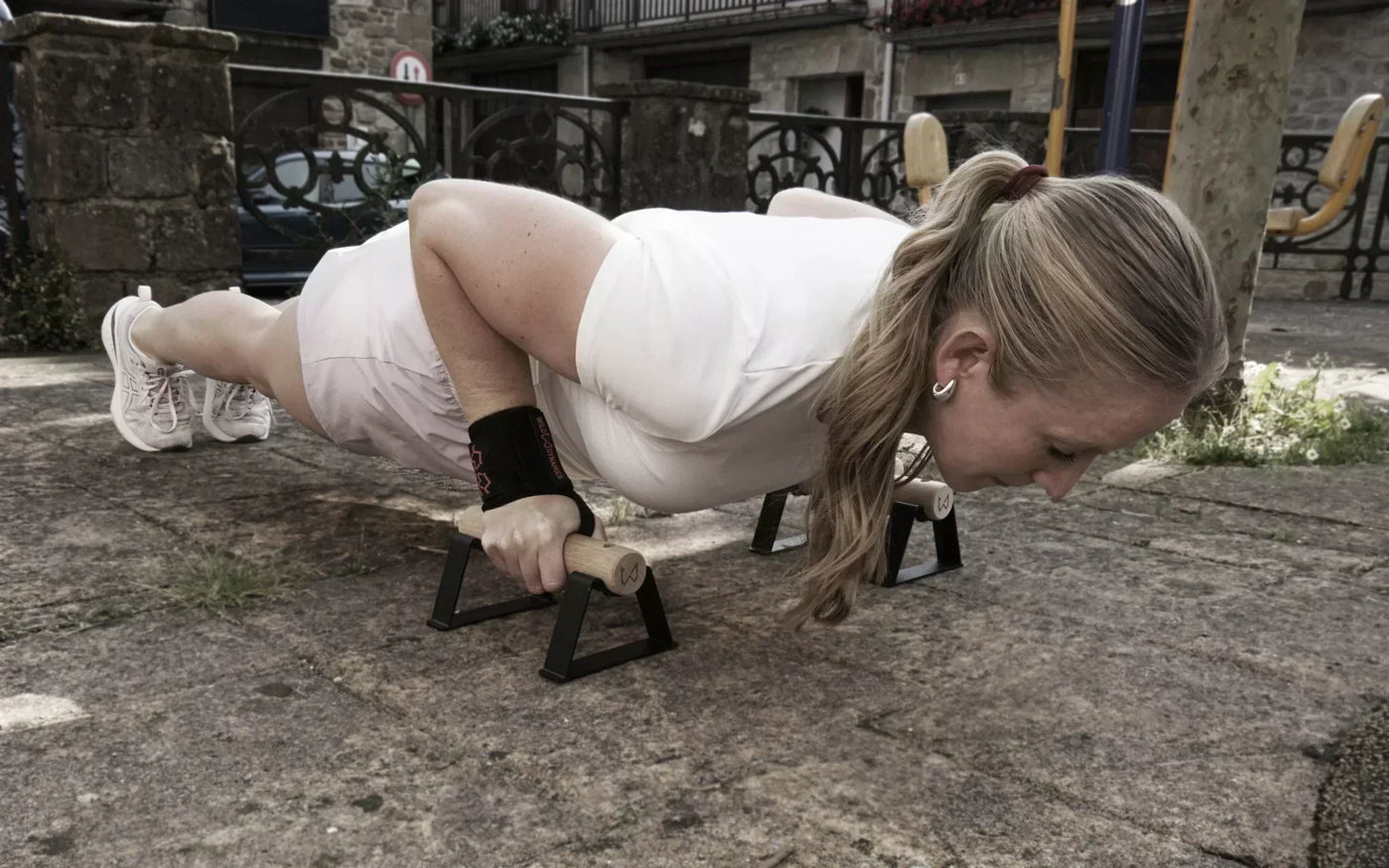
Why explosive push-ups matter
Explosive strength is the ability to generate maximum force in minimum time. In calisthenics that translates directly to stronger bar transitions, sharper muscle-up attempts and faster, more controlled direction changes. Explosive push-ups — also called plyometric push-ups — are the foundational drill to train that quality with nothing but the floor.
Plyometric training means explosive exercises where force is generated quickly enough for the body to briefly leave the ground. The mechanics are simple: you lower under control, then press away from the floor with deliberate speed while keeping a clean, rigid body line. No sloppy hips. No chicken-winging elbows. Just fast, precise movement that teaches your nervous system to fire harder.
Pre-requirements before you start
Plyometric push-ups amplify whatever is already there — good technique and bad technique alike. Build these four foundations first. They will make every plyometric rep safer and more effective.
Master the standard push-up — 10 to 15 clean reps
Chest touches the floor, elbows stay at roughly 45° and hips do not sag at any point. If that standard is not consistent yet, train on an incline or use parallettes to keep every rep smooth. See the Calisthenics for Beginners guide for a full baseline plan.
Build scapula and shoulder stability
Healthy explosive work starts with strong shoulder blades. Use scapula push-ups and ring support holds to train both retraction and protraction before adding speed. Aim for a 30-second ring support hold before progressing.
Strengthen wrists and elbows for impact
Plyometric push-ups load the wrists and elbows significantly more than controlled reps. Add gentle wrist rocks, light forearm work and controlled holds before your session. Soft wrist wraps and elbow sleeves can keep both joints warm and improve blood flow through heavier sets. Not sure which wrist wrap type suits your training? See the hard vs soft wrist wraps guide.
Understand full-body tension
Explosive strength is not just arms. The whole body works together as one rigid unit. Think of a loaded spring: ribs gently down, glutes squeezed, legs long and hands actively gripping the surface. Without total-body tension, power leaks before it reaches the floor.

Plyometric push-up progression ladder
This seven-step ladder shows the full path from standard push-ups to band-resisted explosive reps. Move to the next step only when the current one is consistent, controlled and lands softly. There is no fixed timeline — quality is the only gate.
How to safely add speed and power
Treat speed as a small, deliberate extra layer on top of solid basics, not as a shortcut to skip them. The three-phase approach below gives your joints, tendons and nervous system time to adapt at each step. Note that tendons adapt more slowly than muscles, which is why plyometric push-up progressions should increase gradually even if the exercises feel easy at first.
Phase 1 — Tempo and acceleration
Lower slowly for 3 seconds, pause 1 second at the bottom, then press up with clear, fast intent. You do not leave the floor yet. The goal is to train the nervous system to fire quickly from a dead stop. 3 to 4 sets of 5 to 6 reps, resting 90 to 120 seconds between sets.
Phase 2 — Low-impact plyometrics
When tempo work feels sharp and consistent, start leaving the floor. Begin on an incline — hands elevated on a box or bench — to reduce landing impact. Progress to flat plyometric push-ups on a mat only when 6 to 8 elevated reps feel soft and controlled. See push-ups on parallettes for an additional progression path with better wrist angles.
Phase 3 — Resistance overload
Loop a resistance band behind your back for extra load near the top of the rep. This trains the hardest part of the movement where power usually drops off. For a full breakdown of band use in training, see the ultimate resistance bands guide.
4-week progression plan
Use this plan as a plug-in to your existing training — it replaces your normal push-up work for 4 weeks. Rest at least 48 hours between explosive sessions to allow full nervous system recovery.
| Week | Focus | Main work | Accessory | Notes |
|---|---|---|---|---|
| 1 | Quality form | Standard push-ups 4×8–12 | Scapula push-ups, ring supports | Stop 2 reps before form breaks |
| 2 | Controlled tempo | Tempo push-ups 4×5–6 (3s down, 1s pause, fast up) | Pike push-ups, wrist rocks | Rest 90–120 s between sets |
| 3 | Low-impact power | Elevated plyometric push-ups 6–8 sets × 2 reps | Band-resisted push-ups 3×5 | Count soft landings only |
| 4 | Integration | 3 rounds: 5 tempo reps + 3 explosive reps | Ring supports 3×20–30 s | Finish the session fresh, not fried |
Who should avoid explosive push-ups temporarily
Plyometric push-ups are not appropriate for everyone at every point in training. Pause explosive work and return to controlled reps if any of the following applies to you right now.
- Acute wrist pain or recent wrist injury. Impact loads transmit directly through the wrist joint. Train on parallettes or an incline until pain-free for at least two consecutive weeks.
- Elbow tendinitis or persistent elbow discomfort. Plyometric push-ups increase peak elbow loading significantly. Add elbow sleeves for warmth and compression on regular sessions, and wait until the tendon is fully settled before reintroducing explosive reps.
- Shoulder instability or recent shoulder injury. Landing impact requires the shoulder complex to absorb force rapidly. Rebuild scapula stability with ring support holds and scapula push-ups first.
- Fewer than 10 clean standard push-ups with full range. There is no safe base for plyometric work yet. Follow the beginner progression in the beginner calisthenics routine until that standard is met consistently.
- Active illness or significant sleep deficit. The nervous system recovers poorly when the body is already under stress. Two or three extra days of rest will do more for your progress than pushing through.
Common mistakes when training explosive push-ups
These mistakes appear in almost every beginner's first plyometric push-up session. Knowing them before you start is cheaper than learning them with an injury. For a broader list of form errors, see the most common calisthenics mistakes for beginners.
Letting form collapse under speed
Hips sag, elbows flare wide and the rep becomes a chest flop rather than a power movement. Keep one straight line from heels to head and hold full tension throughout. If form breaks, slow down.
Skipping warm-up and mobility
Cold joints and stiff wrists are the fastest route to a strain. Follow the calisthenics warm-up guide before every explosive session — it takes 8 to 10 minutes and significantly reduces injury risk.
Skipping the basics
Explosive training rewards athletes who already have clean fundamentals. There is no shortcut. Master full-range standard push-ups first. See the beginner calisthenics routine for a structured starting point.
Training explosive push-ups every day
The nervous system needs 48 hours to recover from high-intensity plyometric work. Two explosive sessions per week is plenty for most athletes. For a full guide on session frequency, see how many days to train calisthenics.
Adding too much too fast
Going straight to flat plyometric push-ups before mastering elevated progressions. Land soft first. Work for height second. The 4-week plan above gives the right pacing.
Equipment that accelerates progress
You need nothing but the floor to start. These tools remove common limiting factors — wrist pain, grip failure, insufficient resistance — so training stays consistent across all four weeks.
Mindset and consistency
Explosive strength adapts slowly. The nervous system responds to consistent, high-quality signals, not to grinding through fatigue. Here is the honest version of what to expect:
- Most athletes notice sharper power output after 2 to 3 weeks of consistent tempo work
- Visible carry-over to muscle-up attempts and bar transitions typically appears within 4 to 8 weeks
- Sleep and nutrition matter more than volume — under-recovered athletes stall fast in plyometric push-up training
- If wrists or elbows are sore between sessions, reduce volume before increasing it. Check the training frequency guide for recovery planning
- Explosive push-ups (also called plyometric push-ups) train fast-twitch power and carry over to muscle-ups, planche progressions and bar transitions
- Plyometric training means explosive exercises where force is generated quickly enough for the body to briefly leave the ground
- Prerequisite: 10 to 15 clean standard push-ups with full range before adding any speed or plyometrics
- The three phases are: (1) tempo and acceleration drills, (2) elevated plyometrics, (3) band-resisted overload
- The 4-week plan runs 2 explosive sessions per week with at least 48 hours between them for nervous system recovery
- Tendons adapt more slowly than muscles — increase plyometric push-up progression gradually even when exercises feel easy
- Progression ladder: standard push-up, tempo push-up, accelerated push-up, elevated plyometric push-up, flat explosive push-up, clap push-up, band-resisted explosive push-up
- Core gear: parallettes for wrist-friendly training, resistance bands for overload, wrist wraps for joint support
- Most athletes notice improved power output within 2 to 3 weeks; visible skill carry-over within 4 to 8 weeks
- Biggest beginner mistakes: skipping tempo phase, training explosive reps every day, adding speed before form is solid
- Pause explosive push-up training with acute wrist pain, elbow tendinitis, shoulder instability or fewer than 10 clean push-ups
- Always warm up before explosive work — follow the calisthenics warm-up guide
- Test your current level with the free Calisthenics Level Test before starting the plan
Frequently asked questions
How many explosive reps should I do per session?
Can I train explosive push-ups every day?
Do I need to clap my hands for it to count?
What if my wrists or elbows hurt during explosive push-ups?
How long until I see real progress?
Should I use parallettes for explosive push-ups?
What is the difference between explosive push-ups and plyometric push-ups?
Ready to train?
Everything you need — parallettes, bands, chalk and joint support — built for calisthenics athletes who train seriously.
Master the slow reps first. Then let the fast ones follow.


