
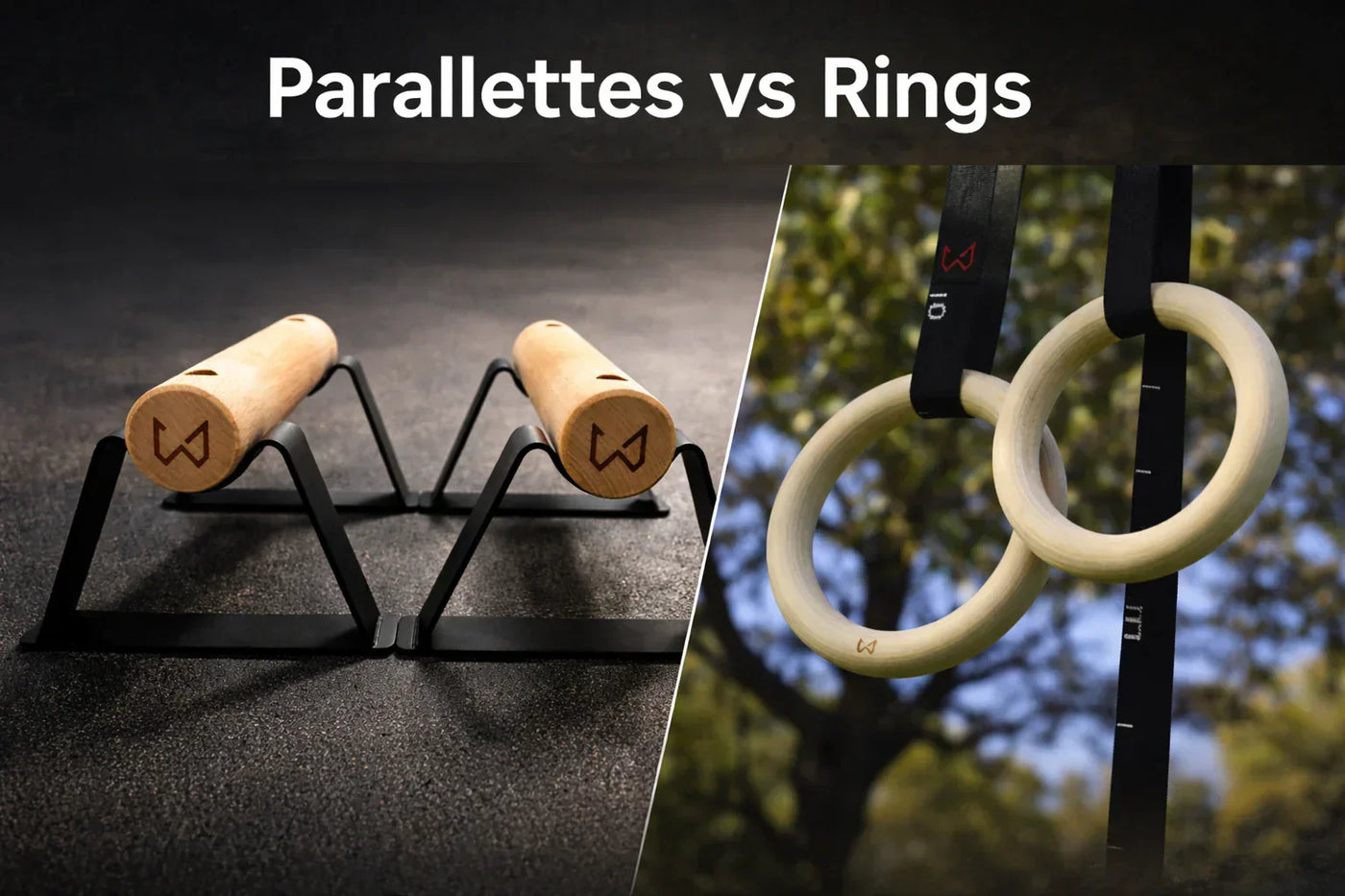
Introduction
Parallettes and gymnastic rings are two of the most popular tools in calisthenics, and both can be extremely effective. The problem is that they feel very different in training, so a lot of people are not sure which one makes more sense for their goals.
Some athletes want better pushing strength, more stability, and a simple setup they can use anywhere. Others want maximum versatility and enjoy the extra challenge that comes with unstable training. That is usually where the comparison between parallettes and gymnastic rings starts.
In this guide, we will break down the main differences between parallettes and gymnastic rings, look at the pros and cons of each, and help you understand which one is a better fit for your calisthenics training.

Quick Comparison Table
| Point | Parallettes | Gymnastic Rings |
|---|---|---|
| Stability | More stable | Less stable |
| Beginner friendly | Easier to learn | Harder at first |
| Best for | Push work, core, balance skills | Pulling, dips, full upper body variety |
| Wrist feel | Neutral fixed grip | Free moving grip |
| Setup | Very simple | Needs hanging point |
| Skill focus | Great for handstands, L sits, planche work | Great for support strength and transitions |
| Best choice for most beginners | Yes | Usually later |
What Parallettes and Rings Have in Common
Both tools are great for bodyweight training. They can help improve upper body strength, core control, and body awareness. They are also portable compared to large gym equipment, which is one reason they are so popular in calisthenics.
With both parallettes and rings, you can train pushing strength, support positions, core work, and skill progressions. They can both be used by beginners and advanced athletes, although the way they challenge the body is quite different.
That is important to understand from the start. This is not really about one being universally better than the other. It is more about which one matches your current level and training goals.
Why Parallettes Are Easier to Control

One of the biggest advantages of parallettes is stability. Because the bars stay fixed on the floor, they are easier to control than rings. This makes them ideal for beginners or athletes focusing on clean technique.
This is especially useful for push ups, planks, L sit progressions, tuck holds, and handstand practice. Many athletes also protect their wrists during these movements by using wrist wraps, particularly during high-volume L-sit and handstand sessions.
Why Rings Feel Harder

Gymnastic rings are harder mainly because they move freely. Even basic support positions feel much more demanding because the shoulders, chest, and arms have to work constantly to control the instability.
Parallettes for Pushing Strength and Skills

Parallettes are especially useful for pushing exercises and skill work. Push ups on parallettes allow a deeper range of motion than floor push ups, and many athletes also find them more comfortable on the wrists.
They are also very practical for plank work, tuck holds, L sit progressions, handstand practice, and planche related training. If you want more ideas, explore our 15 parallette exercises or the dedicated parallettes core exercises guide.
Rings for Pulling and Overall Versatility

Rings are extremely versatile because they open the door to both pushing and pulling exercises in a very free setup. Rows, pull ups, dips, support holds, and transitions all become possible with one tool.
Which One Is Better for Beginners
For most beginners, parallettes are usually easier to start with. They are more stable, simpler to set up, and often feel less intimidating. They are also great for learning body tension, basic pushing strength, and early skill progressions.
Rings can still be used by beginners, but many new athletes find them harder to control right away.
If you’re just starting out, the Beginners Collection is the perfect place to begin.
Which One Is Better for Wrist Comfort
For many athletes, parallettes feel better on the wrists because the hands stay in a more neutral position. This is especially helpful during push ups, planks, and handstand work.
Rings can also feel good on the wrists because the hands are free to rotate naturally.
Do You Really Need to Choose Just One
In reality, many athletes benefit from using both. Parallettes are excellent for stable pushing work, balance based practice, and skill progressions. Rings are excellent for versatile upper body training and unstable strength work.
If someone can only buy one tool, the choice depends on priorities. Looking for the highest quality option? Check our best calisthenics parallettes in 2026 guide.
FAQ
Are parallettes better than rings for beginners?
For many beginners, yes. Parallettes are more stable and easier to control, which makes them more beginner friendly in a lot of cases.
Are rings harder than parallettes?
Yes, in most cases rings feel harder because they are unstable and require more shoulder control.
Can you build muscle with parallettes?
Yes. Parallettes are very effective for building pushing strength, shoulder stability, and core control.
Can you use both parallettes and rings together?
Yes, and many athletes do exactly that. The two tools complement each other very well.
Choose the Tool That Matches Your Goal
Parallettes and gymnastic rings are both valuable for calisthenics, but they are not best at exactly the same things. Parallettes are usually the better choice for stable pushing work, beginner progressions, and skill focused training. Rings are usually the better choice for versatility and unstable upper body strength.
If your goal is to build clean technique, better control, and stronger pushing patterns, parallettes are often the easier and more practical starting point.


