
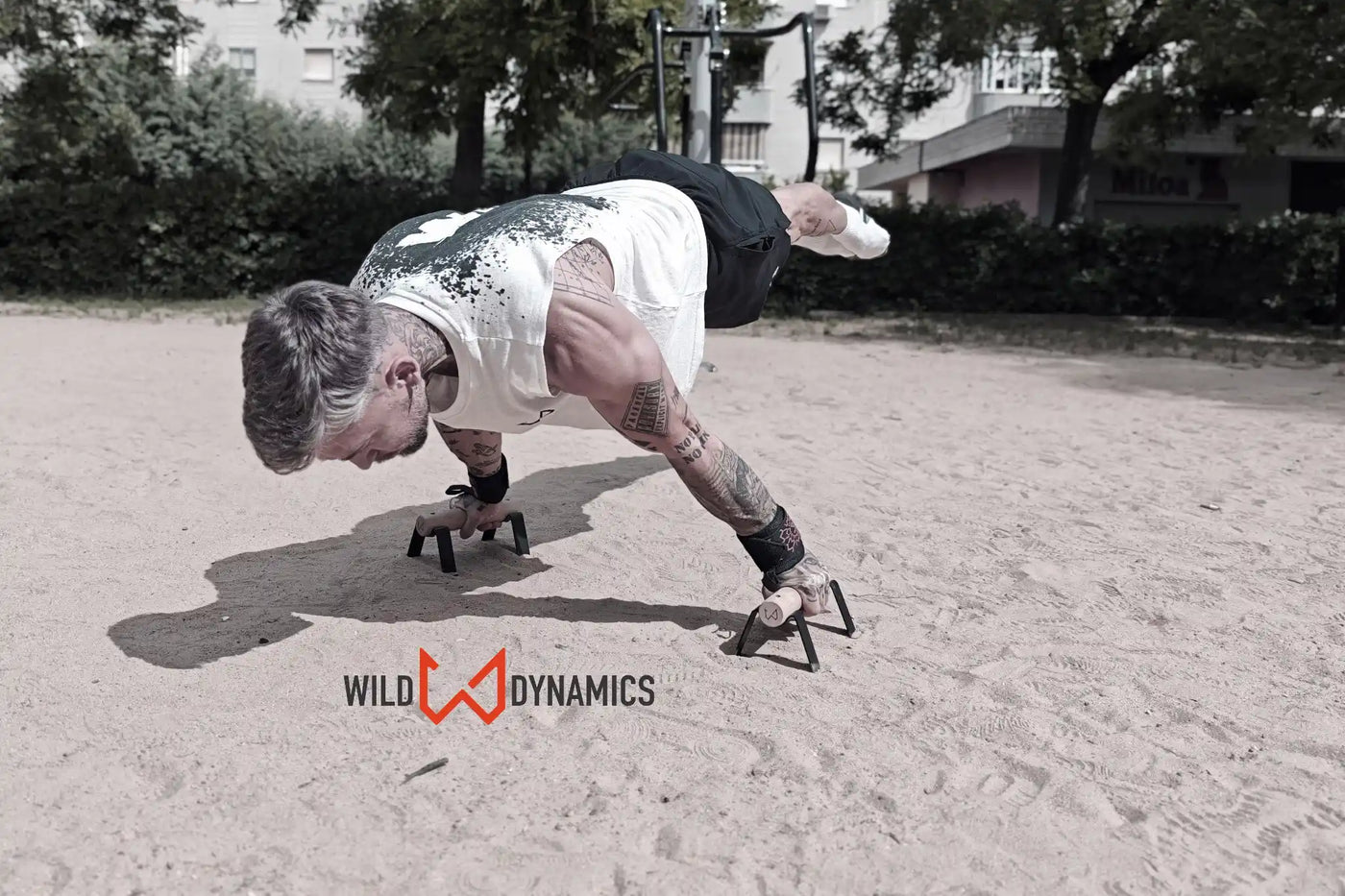
Introduction
Parallettes are simple, portable, and allow you to build real strength using only your bodyweight.
Most people start using parallettes to improve their push-ups or take pressure off their wrists. But once you get started, it becomes clear they can do much more than that. From your first plank hold to advanced skill work, parallettes offer a complete training system in a compact setup that fits any space.
This guide covers everything you need to know to start training with parallettes from scratch. You will find beginner routines, core exercises, push-up technique, skill progressions, and a clear path forward as you get stronger.
If you are still deciding which parallettes to get, check out our Best Small Parallettes in 2026 guide or go straight to the Wild Dynamics Antlettes product page.

Why Train With Parallettes
Parallettes are versatile in a way that few training tools are. You can develop pushing strength, core stability, and balance all with the same pair of bars.
The neutral grip position is one of their most practical advantages. Many people experience wrist discomfort during floor push-ups or planks because the wrist is forced into full extension. On parallettes, your wrists stay in a more natural angle, which makes training more comfortable and often allows for a greater range of motion.
There is also a control element that is harder to develop on the floor. Because you are gripping the bars, your shoulders and core have to stay engaged throughout every movement. Over time, this builds better body awareness and cleaner technique that carries over into everything else you train.
How to Start Training on Parallettes
If you are new to parallettes, the best approach is to start simple and master the basics before adding complexity.
A Beginner Parallettes Workout is the right starting point. It combines pushing movements with basic holds so you can build strength while learning how to stabilise your body on the bars. You do not need to be fit to begin. The routine is designed to meet you at your current level.
At the same time, working on a few fundamental skills early on makes a big difference. The First 5 Parallettes Skills Every Beginner Should Learn covers movements like planks, tuck holds, and early L-sit progressions. These teach you how to create tension, control your body position, and move with intention rather than just going through the motions.
Once you have these basics down, progressing to more demanding work becomes much more straightforward.
Not sure where your fitness level is right now? The Wild Dynamics Calisthenics Level Test gives you a clear picture of your starting point and what to focus on first.
Core Training on Parallettes

Core strength is the foundation of almost everything in calisthenics. Parallettes are one of the best tools for building it.
Exercises like plank holds, tuck holds, and L-sit progressions require your entire midsection to stay active while your shoulders support your weight. This creates a type of functional strength that directly improves your pushing movements, your balance work, and your overall body control.
A focused session of Parallettes Core Exercises can improve stability and posture in ways that carry over into sport, daily movement, and every other exercise you do on the bars.
Push-Ups on Parallettes

Push-ups are one of the most important exercises you can do on parallettes, and one of the first things worth learning properly.
Because your hands are elevated off the floor, you can lower your chest deeper than during standard floor push-ups. This greater range of motion increases the demand on your chest and shoulders and helps build more complete upper body strength over time.
The grip position also keeps your wrists in a more natural angle, which many people find significantly more comfortable during longer training sessions.
Learning how to do push-ups on parallettes with proper technique is one of the most important early steps in building a strong foundation. Get the mechanics right from the start and everything that follows becomes easier.
The First Skills to Learn as a Beginner

Before moving into more advanced training, a handful of foundational skills are worth focusing on first.
The First 5 Parallettes Skills Every Beginner Should Learn includes plank holds, tuck holds, L-sit progressions, and controlled push-up variations. Together they teach you how to stabilise your shoulders, engage your core, and maintain proper body alignment under load. These are not just warm-up movements. They are the building blocks that make every more demanding exercise possible.
Even something as straightforward as holding a strong plank on parallettes develops the kind of shoulder and core stability that directly feeds into skill work, strength progressions, and injury resilience.
Once these movements feel solid, you are ready to start pushing further.
Advanced Parallettes Exercises

As your strength and control develop, parallettes open up a wide range of advanced movements.
Exercises like tuck planche variations, pseudo planche push-ups, handstand work, and more demanding core progressions require a higher level of body control and structural strength. They are challenging by design, and that is part of what makes them effective.
The most important thing is not to rush into these before you are ready. Advanced Parallettes Exercises become significantly more effective when you already have a solid base from your beginner training. Progressing gradually leads to better results, cleaner technique, and fewer setbacks along the way.
For a broader look at what is possible, the 15 Best Parallettes Exercises guide covers movements across all levels in one place.
Parallettes vs Gymnastic Rings

A common question in calisthenics is whether parallettes or rings are the better choice, and the honest answer is that it depends on what you want to develop.
Parallettes are stable and easy to control. That makes them a strong starting point for building pushing strength, core work, and balance-based skill training. Beginners generally find the fixed surface easier to learn on.
Gymnastic rings are less stable, which is what makes them harder. The instability demands more muscle activation throughout every movement. They also allow for both pushing and pulling work, which gives them broader exercise variety. But they have a steeper initial learning curve.
For a full breakdown of how the two compare across different training goals, read Parallettes vs Gymnastic Rings: Which Is Better for Calisthenics?.
Most athletes end up using both eventually. But for pushing strength, skill progression, and daily training, parallettes are the more accessible place to start. If you are ready to explore rings, you can find quality Gymnastic Rings in the Wild Dynamics equipment range.
How to Build a Simple Parallettes Routine
You do not need a complicated program to make progress. A simple, consistent structure works well for most beginners.
A balanced session could include one pushing movement, one core exercise, and one skill progression. For example, push-ups on parallettes paired with a tuck hold or L-sit variation and a basic core movement like a plank or knee raises gives you a complete workout in a short time.
Training two to three times per week is enough for most people starting out. For practical guidance on structuring your week, the How Many Days to Train Calisthenics guide helps you plan a sustainable schedule.
Consistency matters more than complexity. A simple routine done regularly will always outperform an ambitious one done inconsistently.
What You Need to Get Started
You do not need much equipment to begin parallettes training. A quality pair of compact parallettes is enough to train everything covered in this guide.
If you are starting fresh, the Wild Dynamics Calisthenics Starter Set includes everything you need to begin training straight away. For parallettes specifically, you can see the full Wild Dynamics Equipment Collection to find the right option for your training setup.
FAQ
Are parallettes good for beginners?
Yes. They are stable, easy to use, and allow exercises to be scaled to different fitness levels. Most people can begin with basic push-ups and plank holds regardless of their current strength.
Do parallettes help with wrist discomfort?
Many people find them more comfortable than floor exercises because the wrists stay in a more neutral position throughout training. This is one of the most commonly mentioned benefits among new users.
How often should I train with parallettes?
Two to three times per week is a good starting point for most beginners. As you build strength and recover faster, you can add sessions or increase the duration of each one. The How Many Days to Train Calisthenics guide covers this in more detail.
Can you build muscle with parallettes?
Yes. Push-ups, holds, and progressive skill work can build significant upper body and core strength over time. The key is consistent progression, not just repeating the same routine indefinitely.
Do I need to be strong to start?
No. The beginner exercises in this guide are designed to meet you where you are. Starting from a lower fitness level is not a problem. The structure is built around gradual progression.
Start Building Strength With Parallettes
Parallettes offer a simple, effective, and accessible way to train calisthenics. With just a few foundational exercises and a consistent schedule, you can build real strength, improve body control, and develop skills that carry into more advanced movements.
Start with the fundamentals. Progress gradually. Give the basics time to become solid, and the more demanding work will follow naturally.


